
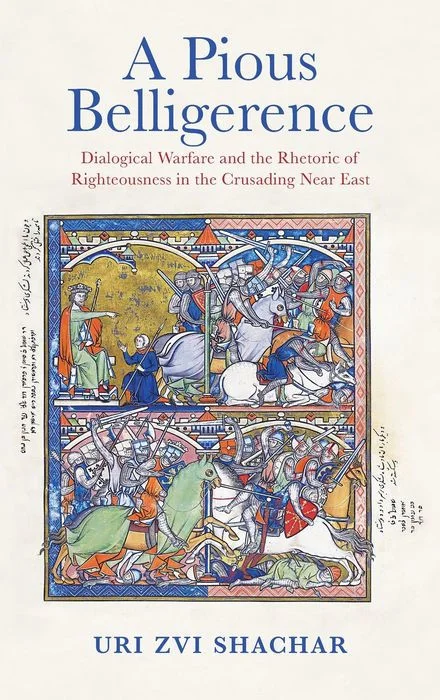
A Pious Belligerence
Original price was: $6.99.$4.99Current price is: $4.99.
Description
In A Pious Belligerence Uri Zvi Shachar examines one of the most contested and ideologically loaded issues in medieval history, the clash between Christians, Muslims, and Jews that we call the Crusades. He does so not to write about the ways these three groups waged war to hold onto their distinct identities, but rather to think about how these identities were framed in relation to one another. Notions of militant piety in particular provided Muslims, Christians, and Jews paths for thinking about both cultural boundaries and codependencies. Ideas about holy warfare, Shachar contends, were not shaped along sectarian lines, but were dynamically coproduced among the three religions.
The final decades of the twelfth century saw a rapid collapse of the Frankish and Ayyubid hegemonies in the Levant, followed by struggles for political dominion that lasted for most of the thirteenth century. The fragmented political landscape gave rise to the formation of multiple coalitions across political, religious, and linguistic divides. Alongside a growing anxiety about the instability of cultural boundaries, there emerged a discourse that sought to realign and reevaluate questions of similarity and difference. Where Christians and Muslims regularly joined forces against their own coreligionists, Shachar writes, warriors were no longer assumed to mark or protect lines of physical or political separation. Contemporary authors recounting these events describe a landscape of questionable loyalties, shifting identities, and unstable appearances.
Shachar demonstrates how in chronicles, apocalyptic treatises, and a variety of literary texts in Latin, French, Arabic, Hebrew, and Judeo-Arabic holy warriors are increasingly presented as having been rhetorically and anthropologically shaped through their contacts with their neighbors and adversaries. Writers articulated their thoughts about pious warfare through rhetorical devices that crossed confessional lines, and the meaning and force of these articulations lay in their invocation of tropes and registers that had purchase in the various literary communities of the Near East. By the late twelfth century, he argues, there had emerged a notion that threads through Christian, Muslim, and Jewish texts alike: that the Holy Land itself generates a particular breed of pious warriors by virtue of the hybridity that it encompasses.
Only logged in customers who have purchased this product may leave a review.
Related products
-
Sale!
History, Reference, War
Caesar’s Civil War
Original price was: $16.99.$12.99Current price is: $12.99. -
Sale!

Health, History, Science
Evolution Gone Wrong
Original price was: $17.99.$12.99Current price is: $12.99. -
Sale!
History, Poetry
An Introduction to Arab Poetics
Original price was: $16.99.$12.99Current price is: $12.99. -
Sale!
Biography & Autobiography, History, Iran, Literary Figures, Middle East
Come, Tell Me How You Live
Original price was: $20.99.$15.99Current price is: $15.99.




Reviews
There are no reviews yet.