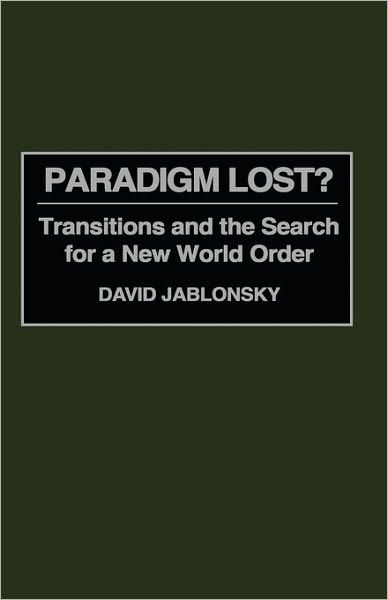
This book examines major historical post-war transition periods, with particular emphasis on the differences and similarities of the American experience after both world wars of this century and with the post-Cold War transition currently underway. Jablonsky provides a strategic vision that incorporates a multilateral, great-power approach to the international relations of our era.
After every momentous event there is usually a transition period in which participants in the events, whether individuals or nation-states, attempt to chart their way into an unfamiliar future. For the United States in this century there are three such transitions, each focused on America’s role in the international arena. After World War I, the American people specifically rejected the global role for the United States implicit in Woodrow Wilson’s strategic vision of collective security. In contrast to this return to normalcy, after World War II the United States moved inexorably toward international leadership in response to the Soviet threat. The result was an acceptance of George Kennan’s strategic vision of containing the Soviet Union on the Eurasian landmass and the subsequent bipolar confrontation of the two super-powers in a twilight war that lasted for more than 40 years.
Sometime in the penultimate decade of this century, the United States and its allies won the Cold War. Once again the United States faces a transitional period, and the primary questions revolve around the management of power and America’s role in global politics. In this regard, the Cold War set in train a blend of integrative and disintegrative forces and trends that are adding to the complex tensions of the current transition. The realist paradigm still pertains in this situation where nation-states are still the primary international actors. In such a world, American government elites must convince an electorate, increasingly conscious of the domestic threats to national security, of the need to continue to exercise global leadership in the management of power. The answer, as Jablonsky demonstrates, is a strategic vision that incorporates a multilateral, great-power approach to international relations.
Only logged in customers who have purchased this product may leave a review.





Reviews
There are no reviews yet.