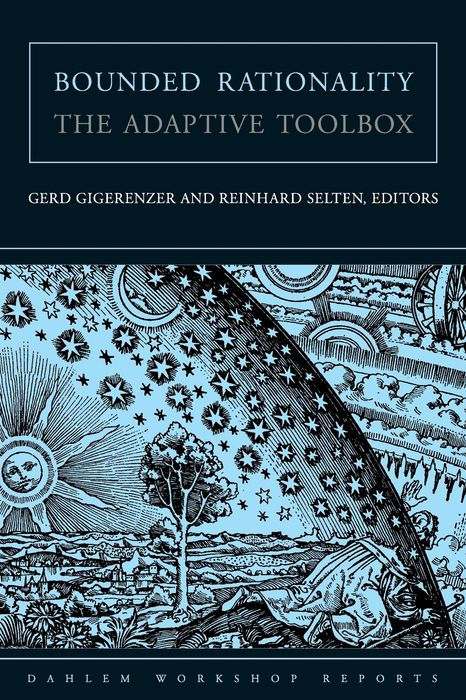
In a complex and uncertain world, humans and animals make decisions under the constraints of limited knowledge, resources, and time. Yet models of rational decision making in economics, cognitive science, biology, and other fields largely ignore these real constraints and instead assume agents with perfect information and unlimited time. About forty years ago, Herbert Simon challenged this view with his notion of bounded rationality.
Today, bounded rationality has become a fashionable term used for disparate views of reasoning.
This book promotes bounded rationality as the key to understanding how real people make decisions. Using the concept of an adaptive toolbox, a repertoire of fast and frugal rules for decision making under uncertainty, it attempts to impose more order and coherence on the idea of bounded rationality. The contributors view bounded rationality neither as optimization under constraints nor as the study of people’s reasoning fallacies. The strategies in the adaptive toolbox dispense with optimization and, for the most part, with calculations of probabilities and utilities. The book extends the concept of bounded rationality from cognitive tools to emotions; it analyzes social norms, imitation, and other cultural tools as rational strategies; and it shows how smart heuristics can exploit the structure of environments.
Bounded Rationality
$4.99
This book promotes bounded rationality as the key to understanding how real people make decisions. Using the concept of an adaptive toolbox, a repertoire of fast and frugal rules for decision making under uncertainty, it attempts to impose more order and coherence on the idea of bounded rationality. The contributors view bounded rationality neither as optimization under constraints nor as the study of people’s reasoning fallacies. The strategies in the adaptive toolbox dispense with optimization and, for the most part, with calculations of probabilities and utilities. The book extends the concept of bounded rationality from cognitive tools to emotions; it analyzes social norms, imitation, and other cultural tools as rational strategies; and it shows how smart heuristics can exploit the structure of environments.
| Book Author | Gerd Gigerenzer, Reinhard Selten |
|---|---|
| Book Series | Dahlem Workshop Reports |
| ISBN | 9780262571647 |
| Language | English |
| Publisher | MIT Press |
| Publication Date | 07-25-2002 |
| Format | eBook |
| Pages | 132 |
Only logged in customers who have purchased this product may leave a review.

Related products
-
The White Shirt
Rated 0 out of 5$14.99Original price was: $14.99.$11.24Current price is: $11.24. Add to cart -
The Evolution of Central Banking
Rated 0 out of 5$149.00Original price was: $149.00.$111.75Current price is: $111.75. Add to cart -
Environmental Racism in the United States and Canada
Rated 0 out of 5$35.95Original price was: $35.95.$26.96Current price is: $26.96. Add to cart -
The Fabric of Civilization: How Textiles Made the World
Rated 0 out of 5$12.99Original price was: $12.99.$9.74Current price is: $9.74. Add to cart


Reviews
There are no reviews yet.